This page contains specialized information intended exclusively for authorized medical professionals. By continuing, you confirm that you are a physician or medical provider.

Autologous Cell Therapies for Cartilage Regeneration in the Knee
TETEC offers two matrix-associated autologous chondrocyte transplantation (MACT) procedures for the treatment of focal cartilage defects in the knee: Injectable MACT and Scaffold-Based MACT. Both use a patient's own cultured chondrocytes to support cartilage regeneration. Learn more about these treatment procedures and their role in clinical practice.
.avif)
Cartilage Lesions of the Knee
Cartilage defects of the knee are a common orthopedic diagnosis. As a result, several thousand surgical interventions are performed in Germany each year to treat cartilage defects of the knee. Without appropriate treatment, these defects may progress and can contribute to the development of osteoarthritis over time [1-3].
Common Causes of Cartilage Lesions of the Knee
Acute traumatic injuries, including sports-related injuries
Repetitive overuse or abnormal joint loading
Osteochondritis dissecans (OCD)
Malalignment or chronic joint instability
Why Cartilage Heals Poorly
The lack of a direct blood supply limits the availability of nutrients and reparative cells
Low cellular activity slows extracellular matrix regeneration
The dense extracellular matrix restricts cell migration
Excessive or persistent loading may impair healing and promote cartilage degeneration
Established Treatment Procedures Compared
For the treatment of cartilage defects of the knee, several procedures are available, including bone marrow stimulation (BMS), matrix-augmented BMS, osteochondral autograft transfer (OAT), and matrix-associated autologous chondrocyte transplantation (MACT). The choice of treatment depends on several factors, including defect size.
UP TO 1.5 cm2
Osteochondral
Transplantation
UP TO 2 cm2
Bone Marrow Stimulation
1-4.5 cm2
Matrix-Augmented Bone Marrow Stimulation
2-10 cm2
Scaffold-based MACT (Matrix-Associated Autologous Chondrocyte Transplantation)
≥ 2 cm2
Injectable MACT (Matrix-Associated Autologous Chondrocyte Transplantation)
0 cm2
1 cm2
2 cm2
3 cm2
4 cm2
5 cm2
6 cm2
7 cm2
8 cm2
9 cm2
10 cm2
11 cm2
Injectable MACT vs. Scaffold-Based MACT
Explore Injectable MACT and Scaffold-Based MACT in greater detail.
Cell-Based Cartilage Regeneration for the Knee
TETEC offers two products for the treatment of knee cartilage defects within the framework of autologous chondrocyte transplantation: an injectable, hydrogel-based cartilage cell transplant (Injectable MACT) and a cartilage cell transplant with a collagen scaffold (Scaffold-Based MACT).
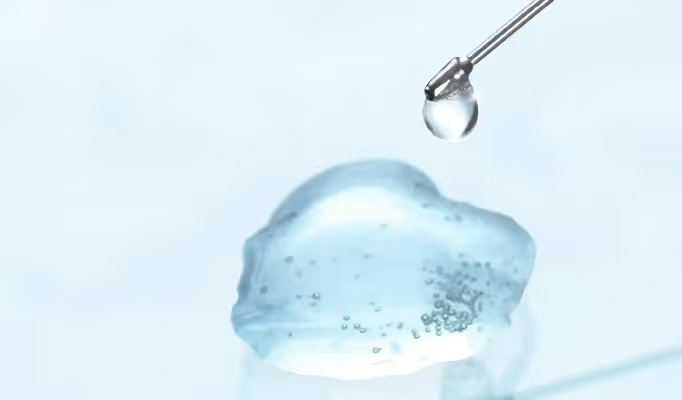
Injectable MACT
Injectable MACT is a cell-based procedure for the treatment of focal cartilage defects of the knee. The procedure uses a patient's own cartilage cells in combination with an injectable hydrogel for transplantation into the cartilage defect [6]. In clinical studies and earlier publications, this procedure has also been referred to as hydrogel-based ACI or Injectable M-ACI.
- A patient's own cartilage cells suspended in an injectable hydrogel
- Minimally invasive arthroscopic transplantation
.avif)
Scaffold-Based MACT
In Scaffold-Based MACT, a patient's own cartilage cells are seeded onto a collagen-based scaffold and transplanted into the cartilage defect [5].
- Collagen-based scaffold seeded with a patient's own cartilage cells
- Transplantation via a small surgical approach (mini-arthrotomy)
Stay Informed About TETEC
Discover the latest TETEC news and stay informed about upcoming conferences.
1. Ding C, Cicuttini F, Scott F, Boon C, Jones G. Association of prevalent and incident knee cartilage defects with loss of tibial and patellar cartilage: a longitudinal study. Arthritis Rheum. 2005;52(12):3918–3927.
2. Cicuttini F, Ding C, Wluka A, Davis S, Ebeling PR, Jones G. Association of cartilage defects with loss of knee cartilage in healthy, middle-aged adults: a prospective study. Arthritis Rheum. 2005;52(7):2033–2039.
3. Houck DA, Kraeutler MJ, Belk JW, Frank RM, McCarty EC, Bravman JT. Do focal chondral defects of the knee increase the risk for progression to osteoarthritis? Orthop J Sports Med. 2018;6(10):2325967118801931.
4. Niemeyer P, Albrecht D, Aurich M, et al. Empfehlungen der AG Klinische Geweberegeneration zur Behandlung von Knorpelschäden am Kniegelenk. Z Orthop Unfall. 2023;161(1):57–64.
5. TETEC AG. Summary of Product Characteristics (SmPC) NOVOCART® 3D. Reutlingen (DE): TETEC AG; 2023. Revision date: 11/2023. PEI.A.11511.01.1.
6. TETEC AG. Summary of Product Characteristics (SmPC) NOVOCART® Inject. Reutlingen (DE): TETEC AG; 2026. Revision date: 02/2026. PEI.A.11763.01.1.
7. Niemeyer P, Hanus M, Belickas J, et al. Treatment of large cartilage defects in the knee by hydrogel-based autologous chondrocyte implantation: two-year results of a prospective, multicenter, single-arm phase III trial. Cartilage. 2022;13(1):19476035221085146.
8. Paul-Ehrlich-Institut. Physician training guide for NOVOCART 3D. Langen (DE): PEI; 2025.
9. Schlumberger M, Schuster P, Bülow HJ, et al. Arthroscopic autologous chondrocyte implantation in the knee with an in situ crosslinking matrix: minimum 4-year clinical results of 15 cases and 1 histological evaluation. Arch Orthop Trauma Surg. 2019;139(11):1607–1615.
10. Data on file. Study report NOVOCART 3D Phase III (AAG-G-H-1202)